During my India GOYA trip, which I wrote about in two articles published in recent weeks, I flew to Singapore for two days for business meetings and took the opportunity to do some GOYA around the city as well. When you arrive in Singapore, it is hard not to wonder about the history behind all the order, prosperity and careful planning you see. I have visited Singapore many times since 1984, so of course I was familiar with its development, but I decided to look into it nevertheless. Singapore’s history certainly did not begin in 1819. The island had been part of the Malay(*) world’s trading networks since the Middle Ages. But the turning point for modern Singapore came in 1819, when Stamford Raffles and William Farquhar arrived on behalf of the British East India Company and established a trading post.
(*) The Malays are a people of Southeast Asia, living particularly on the Malay Peninsula and the surrounding islands, with shared linguistic and cultural ties. The expression “the Malay world” refers not only to present-day Malaysia, but to a much wider geographical area.
Historically, the Western powers, including the British, the Spanish and the Portuguese, sought routes into the then-unknown world partly because the Ottoman Empire dominated trade across the known world. Their predicament was that relations with the Ottomans largely meant either paying tribute under a peace agreement or facing annual campaigns for plunder. Alongside these efforts to explore unfamiliar territories, the British, it seems to me, chose a more dependable route: they advanced through companies they established and supported to trade directly with the East. Even today, we remain far from matching the scale and organisation of the trading networks established by Arab merchants after the spread of Islam, or by the British in later centuries. But trade in those days was a bloody business. At times, it cost merchants, or the officials who supported them, their lives.
These trade routes were not simply corridors along which goods travelled. People, ideas, beliefs and cultures followed the same routes. Dervishes and Sufi mystics played as important a role as merchants in the spread of Islam in Central Asia. Zengi Ata, whom I researched in connection with my trip to Almaty, is an interesting example. Originally named Ay Hoja, this 13th-century Sufi mystic was known as Zengi Ata, meaning Black Father, because of his dark complexion. He belonged to the tradition of Ahmad Yasawi. Local accounts describe him working as a shepherd and offering people religious and moral guidance. His mausoleum, near Tashkent in present-day Uzbekistan, has welcomed visitors for centuries. So it was not economic interests alone that made these trade routes endure, but also the human and cultural relationships established along them. Perhaps this is one place to look for the foundations of what we now call globalisation.
SINGAPORE: A CITY-STATE
Singapore’s location is a tremendous advantage. It sits on the main shipping routes between the Indian Ocean and the South China Sea, at the entrance to the Strait of Malacca, right at the crossroads of trade between China, India, the Malay Archipelago and Europe. When the British combined this geographical advantage with a policy of free trade, the port grew rapidly. Chinese, Indians, Malays, Arabs and Europeans settled here. Still no sign of the Turks, though! But then, back home, if someone works, earns money and succeeds abroad, we say they have “fled the country”.
The foundations of today’s multicultural, multireligious Singapore date back to those early years. Interestingly, Raffles Place was already being planned as a centre for banks, merchants and shipping companies in the 1820s. The geographical layout of today’s skyscraper-filled financial district was, in fact, established two hundred years ago. What followed was British colonial rule, Japanese occupation, self-government in 1959, entry into the Federation of Malaysia in 1963 and independence in 1965. At independence, Singapore had a small domestic market, virtually no natural resources, dependence on imports even for water and food, and high unemployment. Despite this, within just a few decades it developed a very different model, built on export-led industrialisation, foreign investment, education, port infrastructure and strong state institutions.
For a country with a population of 6.21 million as of June 2026, reaching approximately S$1.4 trillion in total merchandise trade in 2025 and handling 44.66 million TEUs of container throughput at its port that same year was no coincidence. So it seems the best traders are not necessarily Jews or people from Kayseri after all. The commercial success of this population, made up of Chinese and Malays brought together by fate, is undeniable.
NO MATTER HOW FAR YOU TRAVEL, THERE ARE SOME THINGS YOU CANNOT ESCAPE
I have visited Singapore many times. My first visit was out of curiosity, more than forty years ago. Since then, I have always come on business, and I still stop by almost every year. On another trip, perhaps my second, I was newly married. My wife was with me, and it was one of those long Eid holidays. I get ill if I do not work during a long holiday, because I am a workaholic. My wife was the only person on the plane wearing a headscarf. It was as though everyone on board had agreed to make us feel we did not belong there. We travelled in a deeply unwelcoming atmosphere. Yet the reason for the long holiday was Eid al-Fitr, and it was our religious festival. Absurdity reigned in the country in the late 1980s. Our country, that is…
Anyway, we arrived and passed through immigration and customs without any trouble. But while waiting at passport control, I could not help feeling alarmed by a warning covering the wall opposite us. It said that using and possessing drugs was prohibited and punishable by death. Strange, isn’t it? They should have told us that before we boarded the plane. In later years, I learned that even the import and sale of chewing gum had been banned.
We got into a taxi. The driver was Chinese, and we communicated in broken words and gestures. He told us that half of Singapore was Muslim and said, “Today is a Muslim holiday. I think they are celebrating their New Year…” When I asked why he thought so, he pointed to an apartment whose balcony alone was brightly decorated and sparkling in the darkness. That made me so happy. I wanted to do the same, and ever since that day I have decorated my home for every Ramadan and Eid. When we reached the hotel, all those unfriendly people from the plane were lined up in front of reception, as if there were no other hotels in town. We had no choice but to join the end of the queue. I was annoyed…
But a young man from reception called us over and quickly checked us in separately. As he wished us a happy Eid, he said, “You should not have to wait in the queue. Besides, you must be newlyweds.” Then he added, “I am Muslim as well.” He had recognised a sister in faith by her headscarf…
Everything in the room really was more luxurious and larger than what we had at home! Yet among the wide variety of treats replenished every day, the only fruit provided consisted of apples and oranges. I asked about it. It turned out that the family I was meeting on business had specifically asked the hotel to serve us these prized imported fruits. Eventually, at our request, they brought us local fruit instead, and we were able to taste a variety of tropical fruits.
SINGAPORE: A SMALL ISLAND WITH A BIG IMPACT
When you arrive in Singapore, it is hard not to wonder about the history behind the order and prosperity you see. Naturally, I did a little research. Singapore’s history certainly did not begin in 1819. The island had been part of the Malay world’s trading networks since the Middle Ages. But the turning point for modern Singapore came in 1819, when Stamford Raffles and William Farquhar arrived on behalf of the British East India Company and established a trading post.
Singapore’s greatest advantage is its location. It lies on the main shipping routes between the Indian Ocean and the South China Sea, close to the southern end of the Strait of Malacca. Its position at the crossroads of trade between China, India, the Malay Archipelago and the West made it one of the region’s major trading centres. When the British combined this geographical advantage with a policy of free trade, the port grew rapidly. Chinese, Indians, Malays, Arabs and Europeans began to settle here. The foundations of today’s multicultural Singapore were largely laid in those years.
To explain Singapore’s approach to government, let me tell you about an election in 2011. To my mind, what experience here has demonstrated is the rule of law and the equality of citizens. With its restrictive laws and strict enforcement, Singapore is, after all, far from being a democracy in which freedoms can be fully enjoyed. As people put it, “Our government behaves like a dictatorship, but it knows us so well that it understands what we will want before we even ask, and keeps us satisfied.”
Singapore had a very interesting election in 2011. The People’s Action Party, or PAP, which had governed the country since 1959, was the favourite, as usual. This time, however, a substantial part of the population was unhappy about rising housing prices, the cost of living and immigration policies. The opposition Workers’ Party challenged a strong slate of government candidates in Aljunied. What made it particularly interesting was a warning from Singapore’s founding leader, Lee Kuan Yew. He told voters that if they elected the opposition, they would regret it for five years. But voters did not heed the warning. The opposition won approximately 55 per cent of the vote, defeating the ruling party’s team, which included Foreign Minister George Yeo. This was the first time in Singapore’s history that the opposition had won a Group Representation Constituency, or GRC. The ruling party still won comfortably nationwide, but its share of the vote fell to 60 per cent, its lowest level since independence. In 2017, Halimah Yacob became Singapore’s first female president as the only candidate who met the eligibility requirements for the presidency. (**)
In my view, these elections is important to understanding Singapore’s approach to government. The state’s achievements may be beyond dispute, but voters do not owe it unlimited obedience. People can appreciate the prosperity provided to them while also challenging their leaders when necessary. And they do so at the ballot box, rather than in the streets. Of course, this does not mean that Singapore is a fully functioning democracy in every respect. The ruling party’s influence over the media, politics and public life, the structural difficulties facing the opposition, and restrictions on freedom of expression remain subjects of debate. But the thought-provoking aspect of Singapore’s experience is this: a strong state is one that can do more than issue orders. It can understand society’s expectations and change its policies when necessary.
As I mentioned, it is no coincidence that a country with a population of just over six million has merchandise trade approaching S$1.4 trillion. Moreover, the vast majority of the cargo passing through its port is not intended for Singapore’s own needs, but consists of transit goods bound for other countries. Yet Singapore’s success is about more than having a good port. Around it, they have built an ecosystem of logistics, legal services, insurance, financing, ship management and commodity trading, supported by advanced, up-to-date technology. A container may be unloaded here, but the ship’s financing and insurance, foreign exchange transactions, commercial contracts and the company’s regional management can also all be handled from Singapore.
With the establishment of the Asian Dollar Market in 1968, Singapore filled the gap between global finance’s time zones, when the American markets had closed and the European markets had yet to open. Today, total assets under management here exceed S$6 trillion, and a very large proportion is invested in other countries. This shows that Singapore is much more than a centre managing its own money. In this sense, Singapore is the Switzerland of our time. It has overcome the disadvantages of being a small island without natural resources to secure a unique position. In short, rather than accepting geography as destiny, they have turned it into a business model. We could do this in the Turkish Republic of Northern Cyprus as well. I will write about that sometime.
Whenever I go to Singapore, I naturally visit banks. I answer the inquisitive questions of leading bankers, each brilliant in their own right, who are curious but know little about nutrition. In fact, we, too, should teach children about nutrition in primary school, as Japan does… As you know, this is what we are doing through the Sabri Ülker Food Research Institute Foundation’s Balanced Nutrition Programmes, reaching millions of students, teachers and parents.
You cannot come to Singapore without visiting its financial centre. We have worked for years with United Overseas Bank, which has long maintained high credit ratings. It is a publicly listed regional family bank, now led by the founding family’s third generation. Once, when I asked why they gave me such a warm reception on every visit, I learned that our group was among the bank’s major corporate clients. Of course, relationships like these are not built overnight. We have worked with this bank for many years as part of our group’s international operations, developing mutual trust over time. We saw the benefits of this relationship and of strong liquidity management both in our major acquisitions abroad and during the syndicated financing process. When growing a business, spotting an opportunity is not enough. You also need the financial readiness and reputation to act when the time comes. Traces of this same approach can be seen in UOB’s own growth story. Visits to the financial centre are essential.
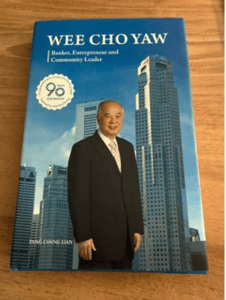
On my last visit, they gave me a biography of Wee Cho Yaw, the patriarch of the family and the bank. The book tells the story of the man who transformed UOB from a small family bank into one of Southeast Asia’s largest financial institutions. Having learned the ropes in his father’s trading company, Wee took over the management of the bank in 1960, focused on foreign trade finance and expanded by acquiring rival banks. The acquisitions of Chung Khiaw Bank in 1971 and Overseas Union Bank in 2001, in particular, turned UOB into a regional force. His success rested on cautious growth, meaning seizing opportunities without taking unnecessary risks; preserving the bank’s financial resilience through rigorous cash and capital discipline; making decisions grounded in personal relationships, meaning knowing his customers and business partners well and building long-term relationships based on mutual trust; negotiating and deciding quickly when opportunities arose; and retaining family control of the bank’s management as it grew. In short, Wee Cho Yaw turned relationships of trust into a commercial advantage and financial discipline into the capacity to grow. He made quick decisions without losing sight of the long term.
The book explores not only banking, but also Wee’s leadership within Singapore’s Chinese community. It gives considerable attention to the transformation of Nanyang University, the modernisation of Chinese clan and hometown associations, and his support for educational and charitable organisations. It is therefore more than the biography of a businessman. It is, in effect, a history of Singaporean business, covering the institutional development of a family company, generational succession, growth through acquisitions and the building of social legitimacy. Wee Cho Yaw managed to professionalise the bank without losing family control, remain defensive during crises while making bold acquisitions when opportunities arose, and complement commercial success with leadership in society. Let me also mention a habit of the boss that I have observed on every visit. Whenever we meet, he has invariably just returned from visiting branches in a particular region. And if we cannot meet, I learn that he is somewhere else, doing his own GOYA.
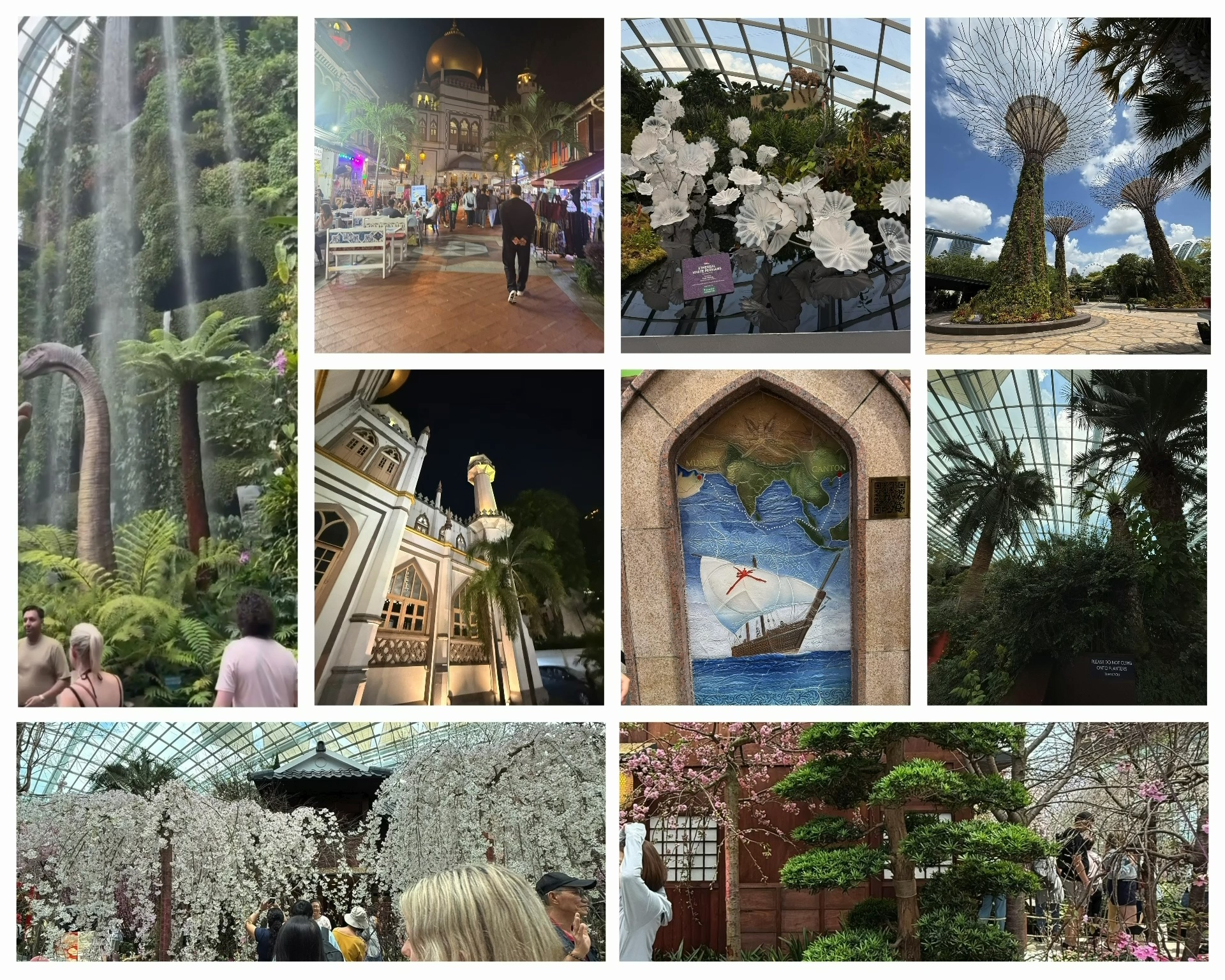
I continue my GOYA through some of the city’s important districts. Singapore’s roots are there to be seen in its streets. When we visit Kampong Gelam, names such as Haji Lane, meaning Pilgrims’ Lane, Arab Street, Baghdad Street and Muscat Street, together with colourful cafés, graffiti, fabric shops, perfumeries and numerous restaurants serving Turkish and Arab food, initially give the impression of a Middle Eastern quarter created later for tourism. Yet the area’s identity goes back to Singapore’s founding years. In the city plan of 1822, it was designated as the area for the Malay ruler, Malay and Buddhist communities, and Muslim merchants. Over time, Muslim merchants from Java, Sumatra, Sulawesi, India and, particularly, Yemen’s Hadhramaut region settled here. Trade in textiles, spices, perfumes and books flourished.
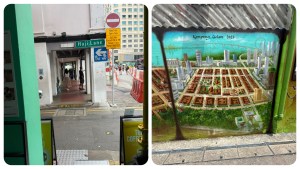
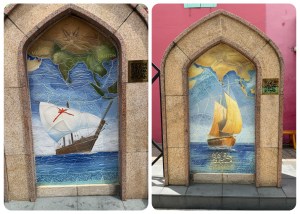
The Arab sailing vessels depicted on the walls and the sea routes stretching from Muscat to Singapore are reminders of this past. Trade across the Indian Ocean carried more than goods. People, beliefs, languages, food and cultures travelled as well. Haji Lane did not get its name by chance. From the late 19th century until the 1970s, pilgrims travelling from Malaysia and Indonesia to Mecca gathered here, found accommodation, shopped and boarded their ships. Sultan Mosque, at the heart of the district, is another of the most important symbols of this history. The first mosque was commissioned by Sultan Hussein Shah in the 1820s, while the gold-domed building we see today was constructed in the 1920s.
Seeing so many Turkish restaurants in Kampong Gelam during the day, I first wondered whether there had been a historical Turkish presence here. In fact, there had not. This was never a Turkish quarter. It was a multicultural trading district made up of Malays, Buddhists, Javanese, Indian Muslims and Arabs. Today’s Turkish restaurants are a more recent addition to this historic Muslim and Middle Eastern identity.
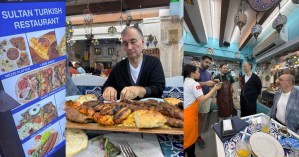
That evening, we sat down at a Turkish restaurant called Anatolia. With hummus, falafel, aubergine mezes, stuffed vine leaves, pide, kebabs, lamb and köfte, the whole of eastern Mediterranean cuisine, from Türkiye to Lebanon and Syria, seemed to come together at our table. When we learned that the owner was Turkish, the conversation grew livelier. In a way, even this meal seemed to tell the story of Kampong Gelam: a culinary continuation of the different Muslim trading communities that had lived side by side on the same streets two hundred years earlier… After dinner, we walked to Sultan Mosque. There were Muslims coming out of the mosque after tarawih prayers, Chinese and Western tourists in front of it, Turkish, Arab and Lebanese restaurants nearby, Malay shops, and even the contemporary cafés of Haji Lane just a few streets away…
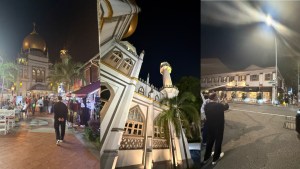
Singapore’s four official languages, English, Mandarin Chinese, Malay and Tamil, are consistent with this social fabric. Chinatown, Little India and Kampong Gelam are more than authentic neighbourhoods that attract tourists. They are present-day reflections of the country’s history of migration and trade. To my mind, Singapore’s real achievement lies not merely in having this diversity, but in being able to manage it. Rather than assimilating its different communities, it allows them to live together while retaining their distinct identities. It preserves its historical identity while building the future upon it.
In Singapore, one of the world’s leading trade and financial centres, you can spend the morning discussing global trade and financial instruments, the afternoon walking along streets where Malay and Arab merchants walked two hundred years ago, and the evening eating kebabs and hummus at a Turkish restaurant before visiting Sultan Mosque. In a single day, you encounter and engage with Chinese, Malay, Indian, Arab, Turkish and Western cultures. None exists in isolation; together, they make up Singapore.
On a visit to Singapore, you see that people have not been content simply to leave nature as it is. Instead, they have planned it, designed it, reshaped it through engineering and placed it at the centre of public life.
Our first stop the next day is Gardens by the Bay. This is not a botanical garden in the conventional sense. It is an answer to the question of how nature can exist in the city of the future. In fact, the story goes back much further. For many years after independence, Singapore described itself as a “Garden City”. In the 2000s, its ambition grew, and it moved towards the idea of a “City in a Garden”. Gardens by the Bay is the result of that vision.
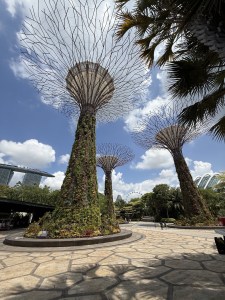
The international master plan competition launched in 2006 attracted 170 firms from more than 24 countries. Construction of the Flower Dome and Cloud Forest began in 2007, and both opened to the public in 2012. The aim was more than simply to plant trees and give people somewhere to stroll. Nature was designed as part of the city’s brand, tourism and public life.
The Flower Dome is one of the most impressive examples. Baobabs, cacti, olive trees, Japanese gardens and seasonal displays all thrive beneath a vast glass dome. The Flower Dome’s volume is equivalent to 75 Olympic-sized swimming pools. Its exterior consists of 3,332 glass panels, and the temperature inside is kept at approximately 23–25°C.
Singapore’s weather is always very hot and humid. The Flower Dome, however, needs to be cool and dry because it replicates Mediterranean and semi-arid subtropical climates. Within minutes, you leave Singapore behind and find yourself walking among plants from California, the Mediterranean, South Africa, Australia and Latin America, in climatic conditions characteristic of those regions.
What makes this possible is not botany alone, but modern engineering. Special glazing lets sunlight in while reducing heat gain. Automated shading systems are at work, and rather than cooling the entire dome uniformly, climate control focuses mainly on the lower areas where people and plants are located. These systems are reported to reduce energy use by approximately 30 per cent compared with conventional technologies.
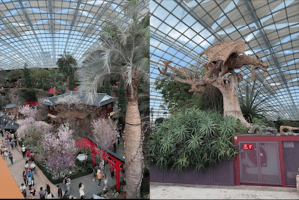
Among the things that impressed me most in the Flower Dome were the baobabs. This extraordinary African tree is also known as the “upside-down tree” because of its swollen trunk and branches that look like roots pointing skywards. It can store large quantities of water in its trunk and withstand drought. This is why it is also called the “Tree of Life”.
Then there are the cacti: spines instead of leaves, surfaces that reduce water loss, and stems that store water. When we look at nature, we often see beauty. Yet the forms found in nature also solve problems. Seen in this light, a botanical garden almost becomes an innovation centre.

In another section, we come across an olive tree. It is so ordinary in our part of the world, but seeing it beneath a giant glass dome in Singapore makes you think again about its history, stretching back thousands of years. Olive oil has been used not only for food, but also for lighting, religious rituals and the anointing of rulers. Sometimes a product we take for granted on a supermarket shelf has a cultural journey of three or four thousand years behind it.

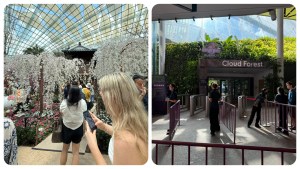
During our visit, one of the liveliest sections of the Flower Dome was the Sakura 2026 display. Gardens by the Bay has held this event for years, highlighting a different region of Japan each year. The 11th edition, in 2026, focused on Japan’s Ishikawa Prefecture. Old Japanese streets, traditional buildings, and samurai and geisha culture were presented alongside cherry blossoms. The display was also timed to coincide with the 60th anniversary of diplomatic relations between Singapore and Japan and featured approximately 40 different varieties of cherry blossom.
At Gardens by the Bay, even water forms part of the design. The lakes collect rainwater and surface runoff, filter it naturally with the help of plants, and allow it to be reused for irrigation. The same system provides habitats for fish and dragonflies. The approximately 14.5 million visitors welcomed by Gardens by the Bay in 2024 demonstrate the project’s scale and success.
After the Flower Dome, we move on to the Cloud Forest and enter an entirely different world within just a few metres. As soon as you step through the door, cool, moist air brushes against your face. Then an artificial mountain, 35 metres high, appears, with a huge waterfall cascading down its side. What is being replicated here is not Singapore’s tropical climate, but the cloud forest ecosystem found at high altitudes. The mountain’s surface is covered with ferns, orchids, mosses, begonias and many other plants that grow at elevation. The Cloud Forest contains more than 72,000 plants.
Inside, we also encounter ancient plant lineages, such as cycads and Wollemi pines. Cycads, which at first glance resemble palms, were extremely widespread during the Mesozoic Era, when dinosaurs roamed the Earth. The botanical garden thus seems to turn into a natural history museum.
Today, the Cloud Forest also hosts Jurassic World: The Experience. Near-life-size animatronic dinosaurs representing Brachiosaurus, Velociraptor and Tyrannosaurus rex have been placed among the plants. Children are encouraged to imitate dinosaur sounds. We do not actually know what dinosaurs sounded like, but the aim here is not to give a palaeontology lesson. It is to spark curiosity and entertain.
The mist surrounding the mountain is more than a visual effect. It provides the microclimate that cloud forest plants need, with temperature and humidity continuously controlled. What you see is therefore the product of a complex engineering system working in the background. After taking the lift to the top, you walk down along the Cloud Walk and Treetop Walk, viewing the plants at canopy level rather than from the ground. Orchid Haven, added in 2021, can display more than 1,000 orchids at a time, with constantly changing displays.

At one point, you look outside and see Marina Bay Sands: that famous structure resembling a giant ship perched on top of three towers. Singapore has not set nature against technology. It has made both part of the same city’s story. Alongside its role as a financial centre, Singapore brings urban planning, tourism, museums, botany and technology together in a single concept, seeking to make itself more attractive. It has adopted the latest marketing concept: experience design. Go and experience it. You will be pleased you did.
(**) Born in Singapore in 1954, Halimah Yacob served as the country’s first female president from 2017 to 2023. She grew up as the youngest of five children in a low-income family. She completed her law degree in 1978 and a Master of Laws in 2001. A mother of five herself, she was elected to Parliament in 2001 and served as Singapore’s first female Speaker of Parliament from 2013 to 2017. In the 2017 presidential election, which was reserved for candidates from the Malay community, she was the only candidate to meet the eligibility requirements and was therefore elected unopposed, without a vote being held.
Resources
1)National Library Board Singapore. Stamford Raffles’s Landing in Singapore. https://www.nlb.gov.sg/main/article-detail?cmsuuid=8b54be13-5b70-44d0-abf6-f9781247686f
2)Enterprise Singapore. (10 Şubat 2026). Review of 2025 Trade Performance.https://www.enterprisesg.gov.sg/resources/media-centre/media-releases/2026/february/mr00626_review-of-2025-trade-performance
3)Maritime and Port Authority of Singapore. (2026). Singapore Posts Record Port Performance in 2025 and Develops Future Readiness through Industry Collaborations for 2026. https://www.mpa.gov.sg/media-centre/details/singapore-posts-record-port-performance-in-2025-and-develops-future-readiness-through-industry-collaborations-for-2026