There is a famous episode in Mark Twain’s The Adventures of Tom Sawyer. On a hot Saturday morning, Tom has to paint the fence as a punishment from his Aunt Polly. More than the work itself, he dreads his friends walking past, seeing him and making fun of him. Then an idea occurs to him… When his first friend, Ben, appears, Tom begins to make painting the fence look like the most enjoyable, most exclusive occupation in the world. Like a meticulous artist, he considers every brushstroke, steps back and judges the effect. Ben initially stops to tease him, but Tom’s indifference to him and complete absorption in his work arouse his curiosity. Eventually, Ben offers Tom his apple for the chance to take the brush and join in this delightful activity. Then come Billy Fisher, Johnny Miller and the others… By the end of the day, Tom’s pockets and stomach are full, and the fence is beautifully painted. This is what we now call gamification! The action has not changed: the same fence, the same brush, the same hot day. Yet a chore has become a source of enjoyment for the children.
Where Did Gamification Come From
Tom Sawyer’s story was written in 1876. The term gamification appeared roughly 126 years later. British designer Nick Pelling first used it in 2002, when proposing a form of game-inspired interface design to make consumer electronics more appealing. The term did not initially gain much traction. In 2010, the popularity of applications such as Foursquare, built around checking in at venues, earning badges and becoming a venue’s virtual “mayor”, brought the use of game design elements in other settings to wider attention. I, too, used the application as I followed my children into the digital world and social media.
Sebastian Deterding, Dan Dixon, Rilla Khaled and Lennart Nacke were among those who examined the question systematically in academic research. In their seminal paper, From Game Design Elements to Gamefulness: Defining Gamification, presented at the MindTrek conference in Tampere in 2011, they proposed a definition: gamification is the use of game design elements in non-game contexts. Every word in this brief definition was carefully chosen. It means using elements of game design without actually playing a game, and with a purpose beyond entertainment. The paper has since received more than 7,700 citations and is one of the foremost contributions to the gamification literature.
Foursquare was a catalyst, but gamification’s wider adoption rested on several developments that were coming together at the time. As smartphones spread, user data began flowing in from every direction. Behavioural economics was gaining popularity, and digital interfaces were becoming part of working life and education. Consulting firms, software developers and academic research funders consequently began investing in the field.
Market research firms predicted that gamification would grow into an ecosystem worth billions of dollars. Companies began gamifying everything from recruitment and training to sales and customer loyalty. Books were now being written about these rapidly multiplying applications!
Let us keep this in mind: gamification is a design practice built around the architecture of human motivation.
Five Books on the Subject
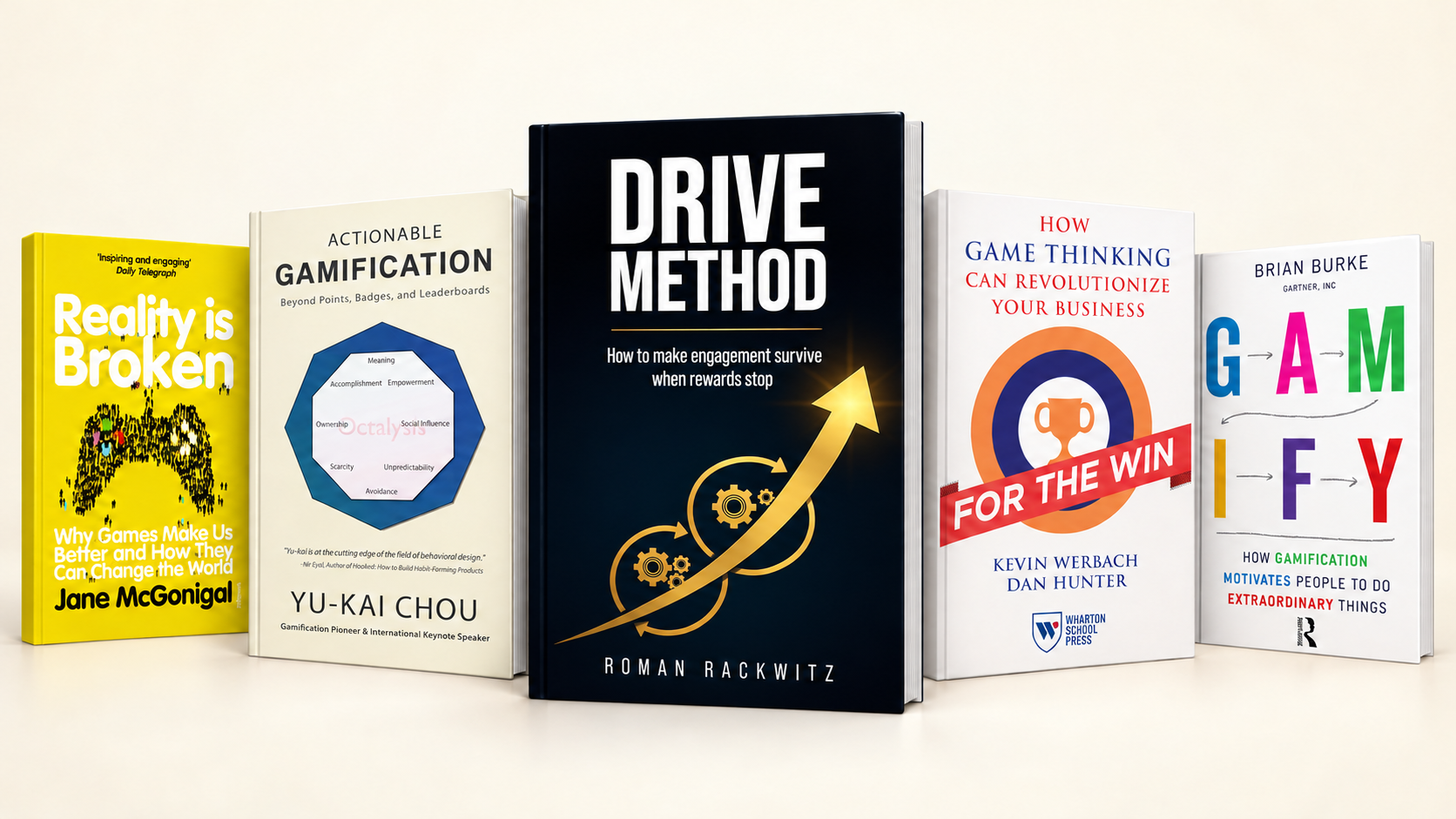
Jane McGonigal’s Reality Is Broken: Why Games Make Us Better and How They Can Change the World, published in 2011, attracted considerable attention. For McGonigal, a game designer, games are not a waste of time. They draw on our evolved curiosity and desire to explore. Gamification incorporates elements such as meaningful challenges, clear feedback and a sense of social belonging. Applying this approach to design could help us address real-world problems, from climate change to shortcomings in education systems.
Kevin Werbach and Dan Hunter’s For the Win: How Game Thinking Can Revolutionize Your Business (2012) was published under the Wharton Business School imprint. While McGonigal takes a broad view, Werbach and Hunter approach the subject from a more corporate perspective, proposing a systematic framework for integrating game thinking into business processes.
Brian Burke’s Gamify: How Gamification Motivates People to Do Extraordinary Things (2014) draws on the case studies he collected over many years as a Gartner analyst. Burke argues that gamification should be built around supporting intrinsic motivation. External incentives alone, he notes, cannot deliver the results you expect.
Yu-kai Chou’s Actionable Gamification: Beyond Points, Badges, and Leaderboards (2015) is the most practical of these books. Chou presents Octalysis, the systematic framework he developed to understand human motivation through eight core drives.
The academic definition frames gamification as the use of game design elements in non-game contexts, while other definitions emphasise the decisive role of intrinsic motivation.
A Striking Finding from Academic Research
One striking finding comes from a classroom experiment conducted by Michael Hanus and Jesse Fox at Ohio State University. In a study published in Computers & Education in 2015, they tested the effects of gamification in the classroom. The experiment was straightforward: two classes taught by the same teacher, following the same curriculum, completing the same assignments and taking the same examinations. The only difference was the gamification system introduced in one class. It featured 22 levels, a currency called “coins” and a leaderboard updated weekly. Data were collected from the students four times over the 16-week term, measuring motivation, satisfaction, effort, social comparison and final examination scores.
Over time, students in the gamified class showed declining intrinsic motivation and satisfaction, felt less empowered, engaged in more social comparison and achieved lower final examination scores. The study reported that the gamified class scored lower than the control group because its intrinsic motivation had declined. The classic gamification combination of leaderboards and competitive mechanics had harmed educational outcomes rather than improving them.
Why? Because gamification requires a much deeper approach to design than simply adding points and rankings. Roman Rackwitz is an expert who works on this very question. His book, published in Turkish as Oyunlaştırma Kitabı: Drive Metodu, Yeni Nesil Motivasyon (The Gamification Book: The Drive Method, A New Generation of Motivation), is the one we will focus on today. (*)
Roman’s story goes back to his school years. Ask his teachers, and they would apparently have described him as a real troublemaker. For him, concentrating in class was impossible, vocabulary lists were a nightmare, and sitting at a desk for hours was torture. Yet the same child could go home and lose himself for hours building model aircraft or pursuing a subject that interested him. He became bold, persistent and eager to take on a challenge.
Why do people give their best in games, sports and hobbies, yet fail to use their full capabilities at work?
Rackwitz spent 20 years investigating this problem, which he had also experienced himself. Drawing on early experiments in gamification, he founded one of Europe’s oldest gamification agencies and developed the Drive Method. Today, he teaches, speaks and advises organisations on motivation design.
Oyunlaştırma Kitabı: Drive Metodu, Yeni Nesil Motivasyon is the product of Roman’s 20 years of work. The book has only recently become available in Turkish, translated by Gamfed volunteers, with a foreword by Ercan Altuğ Yılmaz, founder of Gamfed Türkiye, the Turkish chapter of the International Gamification Federation. Yılmaz offers a lovely analogy in his foreword: a Turkish table is an expression of hospitality thought through from beginning to end. From the dishes and desserts to the presentation and music, every detail forms part of a whole prepared with the guests’ enjoyment in mind. A gamification project, he argues, should have the same coherent focus on people. He proposes an approach he calls “gamify like a Turk”.
What Is Holding the Modern Workplace Back
Many modern workplaces are losing ground. The reason is neither a shortage of talent, nor poor recruitment, nor weak leadership. Our author argues that the real problem is that most companies still operate with systems designed for an entirely different century.
In the industrial age, productivity was measured by how quickly a worker could tighten bolts on an assembly line or fit components into place. Management systems were built around this simple equation, and they worked like clockwork in their day. In the knowledge economy, however, the same system no longer works. Creativity, problem-solving and adaptability cannot be mass-produced like machine parts. Doubling someone’s working hours does not double the value they create. Roman illustrates the problem of workplace engagement using figures published by Gallup in 2017. According to those figures, around 85% of employees worldwide were either not engaged or actively disengaged at work, with the resulting annual loss of productivity estimated at approximately $7 trillion. For comparison, this was about 1.4 times Japan’s annual GDP in 2017. That is the visible cost. The less visible consequences are deeper problems such as slower innovation, declining quality and talented people moving to other jobs or employers.
Roman gives the example of professional athletes. They work both extremely hard and more intelligently: nutrition, sleep, training intensity, recovery, psychological preparation… Every variable is planned, and nothing is left to chance in helping an athlete perform at their best. Today’s knowledge workers, by contrast, are expected to deliver mental excellence without the necessary conditions, feedback or environmental support. That is hardly a strategy. It is simply hope.
This reminded me of Time Management, the last paper-based diary system I used. It was appealing and enjoyable. But maintaining it and keeping track of everything was exhausting…
For managers, sustaining high performance is a way of life. I can recommend a programme called Corporate Athlete. We took part as a team and benefited greatly. For a while, of course… (**)
How to Achieve High Performance
According to Roman, we first need to understand how motivation works at a biological level. As neuroscientist Andrew Huberman explains, dopamine is a molecule that deepens our focus and encourages us to take action. Oxytocin and vasopressin come into play in bonding: the former fosters trust and strong bonds within a group, while the latter strengthens the impulse to pull together in the face of external threats.
Yet it would be wrong to treat motivation as a purely biological matter. Self-Determination Theory, developed by psychologists Edward Deci and Richard Ryan in the 1980s, emphasises the importance of autonomy, competence and relatedness in motivation. People may show greater willingness and persistence when they enjoy what they do, or when they identify with its purpose and find it worthwhile. We therefore need to go beyond external incentives and create conditions in which employees can act of their own volition, feel capable and experience a sense of belonging.
It matters how engaged good employees are in their work, but high engagement can coexist with low motivation. For example, if a fitness app awards similar points for light and strenuous exercise, many users are likely to take the path of least resistance. Technically, the app is being used, but the real goals, such as building strength or endurance, are lost. We see something similar in education. Rather than tackling challenging assignments or studying difficult subjects they do not yet understand, students choose courses in which results come easily. They are active, as we can see, but they are not progressing. They are, in a sense, just spinning their wheels!
Gamification Does Not Make Boring Work Fun
We tend to believe that gamification will make everything enjoyable. On this view, the moment you add points, levels and badges, even the dullest task turns into an exciting adventure. As though annual budget reports and compulsory company training could suddenly feel like playing a game…
The aim of gamification is to draw on the enjoyment we find in games and design work so that people can take pleasure in doing it. A well-gamified system does not replace your favourite game; becoming a game is not its purpose anyway. Gamification means increasing autonomy, improving feedback, creating cycles of progress and introducing small surprises. What changes is how people perceive and experience the tasks they perform.
Still, I believe people ultimately need to get used to working hard, even to develop a taste for it. And that can only come through hard work itself.
Is Motivation a Matter of Character
Can we say that some people are naturally more motivated than others, that those with fire in their bellies succeed and those without it do not? I very much doubt it. That belief is an easy way out. If motivation were purely an individual trait, high-performing employees would work wonders in every environment. What we actually see is that employees can achieve extraordinary things when the conditions are right.
I believe optimism and the habit of motivating oneself can be learnt.
We need to look at the systems in which people work. Motivation is a matter of design. In my article about Kat Holmes’s book Mismatch, I asked: how often have you said to yourself, “Don’t they think when they do this?” Have you ever even raised your voice so that those around you would know how annoyed you were? Whatever prompted you to feel that nobody had thought about your needs, I argued, there was probably a design problem underneath it. Gamification is similar. If you are interested, you can read the article here: https://muratulker.com/uyumsuzluk-hic-dusunmuyorlar-mi-boyle-yaparken/
The Drive Method
The Drive Method consists of five steps: Current Situation, Matching System Structure, Design Engineering, Capabilities and Resources, and Oversight and Alignment. Each step is a decision-making process in its own right, and the next cannot begin until the previous one is complete. Our author particularly stresses that the sequence is strict: skipping a step or changing the order undermines the method’s logic.
Step 1: Current Situation
Diagnosis is the central issue. Poor results in performance and other measures can only be addressed once the underlying problems have been identified. Only then can we establish and focus on the kind of motivation the current environment requires. The existing systems, culture and tools may not support that form of motivation. The result may be conflicting demands, passive resistance, superficial engagement and disengagement from the company. Attempts to compensate for this mismatch commonly involve micromanagement, excessive oversight and stronger incentives.
Step 2: Matching System Structure
Design tools such as reward programmes, bonus structures, training sessions and checklists are used to establish what will be done to address the problem, how it will be done and what outcomes are possible.
According to Roman, explicit tools work for repetitive, standardised, outcome-focused tasks. Indirect tools are more useful in activity-focused processes such as creativity, problem-solving and collaboration.
Step 3: Design Engineering
If the diagnosis points to a lack of motivation or to external regulation, Roman recommends conventional operational tools such as rewards, training and small adjustments. Otherwise, if the aim is to help people identify with the work or become intrinsically motivated, he recommends the IntrinsiQ Performance approach, explained in Step 5…
Step 4: Capabilities and Resources
At this stage, we examine whether the organisation has the capabilities to sustain the system. This is where the vast majority of disappointments arise in practice. The design is flawless and the system works technically, yet within a few months everything reverts to the way it was. According to Roman, the problem is a lack of organisational capacity to support the system. Five critical capabilities are needed to close that gap:
- Behavioural design literacy.
- Signal and feedback literacy.
- Infrastructure that supports autonomy.
- Maintenance and iteration.
- Cultural readiness.
When these capabilities are missing, the organisation quickly returns to old habits. The key is to train the right people in the right way to build these capabilities, or to work with an external expert until your organisation has developed the knowledge it needs.
Step 5: Oversight and Alignment
Motivation systems often fail not because they do not work, but because decision-makers cannot see their results clearly enough. The traditional performance management system, organised around company objectives, KPIs, financial results and quarterly cycles, needs to be connected to the motivational architecture built through the IntrinsiQ Performance system. Results should then be evaluated in that context.
The IntrinsiQ Performance system is a model developed by Roman Rackwitz that aims to activate people’s intrinsic motivation, encouraging them to participate more willingly in an activity and perform better over time. Its central idea is to make the work itself interesting, meaningful and conducive to growth, so that performance can be sustained.
The model describes a cycle that begins with curiosity. First, something catches a person’s attention and makes them want to explore. That curiosity becomes interest when they find a connection between themselves and the work. They then see how their efforts benefit others. Having a choice in how to proceed develops their sense of autonomy. Through experimentation, feedback and visible progress, they develop mastery. Mastery gives rise to new questions and challenges, renewing curiosity and keeping the cycle going.
Consider, for example, an employee who handles customer complaints. They may become curious when they notice the same complaint recurring. Given the opportunity to investigate, their work becomes more than simply logging complaints: it becomes a problem they want to solve. Curiosity thus develops into interest.
Seeing that their solution resolves customers’ problems and reduces colleagues’ workloads makes their contribution to others visible. When their manager gives them the authority to choose between possible solutions and make decisions within defined limits, their sense of autonomy grows. As feedback helps them analyse problems more effectively and develop better solutions, they feel that they are gaining mastery.
This progress may spark curiosity about more complex problems, and the cycle begins again. In the IntrinsiQ approach, the manager’s role is to create a working environment in which employees can be curious, see their contribution, make decisions and develop.
Ultimately, a long-term cycle of evaluation needs to be established.
Looking back now, I remember that when I was deeply involved in the organisation as an executive, we applied many of these and similar systems, even without knowing it. Today, with greater accumulated experience and the conveniences of digital technology, studies of these ways of working that we call gamification, their results and recommended methods have found their way into books. How welcome that is! I recommend reading them, particularly to learn from the case studies. But remember: in business, two times two does not necessarily make four. The answer can be anything from three to five. And if 2 × 2 = 22, so much the better. Believe me, I am not making this up. It really can happen!
References
(*) Rackwitz, R. (2026). Oyunlaştırma kitabı: Drive metodu, yeni nesil motivasyon [The gamification book: The Drive Method, a new generation of motivation] (Gamfed Volunteers, Trans.). The Kitap Yayınları.
(**) Loehr, J., & Groppel, J. (2008). The Corporate Athlete Advantage, The Science of Deepening Engagement. Human Performance Institute.
Note: This open-source article does not require copyright and can be quoted by citing the author.